Dog Eat Dog
Mia Ballard’s Shy Girl and Some Wild Speculations on How We Got Here

When the news broke about Hachette canceling the US publication of Mia Ballard’s Shy Girl due to accusations of AI use, I didn’t hesitate: I logged onto Amazon and bought the last self-published paperback copy that was available from a secondary seller. A day later, I managed to find the version published by Hachette in the UK on AbeBooks and nabbed that one too.
Since AI-assisted art has entered public discourse, I’ve observed a weird allergy on the part of both detractors and boosters to engaging with the actual works produced this way, especially works of literature. This first struck me when reading fiction writer Ted Chiang’s August 2024 New Yorker essay “Why AI Isn’t Going to Make Art.” It lavishes an entire paragraph on recapping a human-made TV commercial for Google Gemini but names only one AI-assisted artist (visual artist Bennett Miller, whose images Chiang calls “striking” and doesn’t otherwise describe)… and it makes no mention of any work of literature, not even the Sheila Heti AI-assisted story “According to Alice” that had run in the pages of that same magazine the previous year.
Less than a month later, Matteo Wong’s counter to Chiang in the Atlantic (“Ted Chiang Is Wrong About AI Art”) was even more content-free, relying heavily on historical precedent and metaphor but describing exactly zero works of AI-assisted art… not even the fiction of Stephen Marche, whose detailed essay about the process behind his own AI-assisted novel had run in the pages of that same magazine the previous year.
AI as a specter looms large, but specific, recent, well-publicized efforts, even those championed by one’s own employer, don’t seem to register. I get it. AI art is in its infancy, and I also find most infants uninteresting. However, the thing about infants is, if you don’t pay any attention to them, bad things tend to happen.
It’s tempting to try to glimpse the glimmering or dystopian future through only analogy, whether positive (AI is the next printing press, camera, microwave, drum machine!) or negative (AI is the next Google Glass, NFT, Metaverse, pet rock!) or just unintelligible (no one knows how to handle the chess computer here but goddamn it, they will try), rather than looking squarely at the confused little lump of the present. I’ve been guilty of that myself. However, Shy Girl is the first time I’ve seen this pattern noticeably start to change. The thorough review by Frankie’s Shelf on YouTube reveals the booktuber’s deep familiarity with this particular text at the level of language, identifying and cataloguing patterns of construction, word choice, and abstraction. This video does eventually turn to questions about what it means, philosophically, if Ballard constructed the book via AI, but it arrives there at the end of a long path through the text in all its specificity.
I admire that approach enormously, even though I don’t agree with all of Frankie’s observations or conclusions. So that will be the way I try to write here: with a foundation in the concrete even when I’m building toward loftier claims. I will start with Mia Ballard’s book and my thoughts on it, place those observations in the context of my own career and experience with writing and publishing, and ultimately, I hope, propose a way of thinking about art, especially literature, in the AI age that allows us to see and name and form substantive, meaningful opinions about what’s right before our eyes. Here goes.
*
Shy Girl tells the story of a young woman named Gia, who loses her job and decides to make ends meet by seeking a transactional relationship with a sugar daddy. Unfortunately for her, Nathan, the sugar daddy she selects, not only asks her to role-play as a dog but imprisons her and forces her to live this debased existence continually for seven years, with ultimately violent and revolting consequences for them both.
It is probably worth stating up front that the reason I read this book is 100% my interest in the use of AI in the arts, especially LLMs for fiction writing. The concept did not hook me organically. I saw the 2022 Norwegian thriller Good Boy – not to be confused with the 2025 American film of the same name – and was not particularly eager to repeat that experience. “Torture porn” more generally is not my favorite.
Still, I’m a fan of both Ottessa Moshfegh and Bret Easton Ellis (American Psycho, anyway), so I can tolerate a good squicking out under the right circumstances. Plus, I was twice a judge for the Shirley Jackson Awards, which meant I made my way through literal stacks and stacks of psychological horror novels, including a lot of books for which I was not the ideal reader but which I felt I still had to judge fairly. I’ve learned, increasingly, both from that experience and from teaching creative writing to college and MFA students, to set aside at least some of my idiosyncratic, personal nice-to-haves when evaluating or giving feedback on projects that, in a vacuum, I would not likely pick up off the shelf.
With all that in mind, here’s my book report.
Plot and structure. This is Shy Girl’s real strength. The timeline especially surprised me. The first 95 pages (almost half the book) cover a matter of days, and I assumed the action that followed would keep the same measured pace. When I turned the page and saw a section marker reading “Year One,” I was genuinely locked in as I realized we’d be rocketing forward in time. It’s odd that this section break comes about ten pages before narrator/protagonist Gia realizes she’s going to be trapped for longer than the agreed-upon eight hours. One might even call that section break placement “a mistake.” But I still dug this sudden shift in scope and scale. The book suddenly got bigger.
I also appreciate that the book takes a cartoonishly bizarre, nightmarish situation and continues to “yes and” it. Personally at least, I have the hardest time with unpleasant subject matter if I’m also bored. Shy Girl does not give the reader time to get bored. Shortly after Gia realizes Nathan intends to hold her against her will, she meets Cupcake, his previous girl-dog companion, whom he implies he’s now going to dispose of. This creates new stakes and heightens dread – is he going to murder Cupcake? How long until Gia herself gets replaced? Then he moves Gia (who he now calls Shy Girl) to a windowless, hyper-feminine bubblegum pink room that is the most vivid setting in the whole book. Then we get a foiled escape attempt, a dental infection Nathan insists on treating by pulling Gia’s tooth himself… and the revelation that all of Gia’s humiliations have been broadcast for Nathan’s fellow sickos on the dark web. Each time we think the situation can’t get worse, it does, until we come to expect new awfulness at these regular intervals.
It’s only then that the book introduces a speculative element: Gia begins physically transforming into a dog, growing fur and claws and doglike ears. The novel doesn’t commit to this as objective reality or a reflection of her unreliability. Nathan seems to notice the changes, taking steps like shaving her, but later she’s inexplicably able to stand upright again, speak human language, and drive a car. You could call it ambiguous, but to me it just feels indecisive. Again, though, it goes all in on the “what the fuck” factor. I think it matters a lot if fiction is memorable, at least contemporary fiction. It gives the reader something to grasp onto, aids recommendations and discoverability, and promotes rereading. Orwell says that Dickens’ characters can be “portrayed on a cigarette-card”; today, an entire novel needs a thumbnail. Giving your book an icon, a mascot, a bestiality hashtag: it’s a vibe.
Gia’s doggishness has plot consequences too. Shortly thereafter Gia gets pregnant, and deals with this situation entirely through feral misbehavior. In hopes of inducing a miscarriage, she bites and eats a sickly rat and a number of other dangerous, non-food items one can imagine a veterinarian picking out of a pet’s stomach. When she does miscarry a stillborn puppy-baby hybrid, she devours her own fetus. And her final attack on Nathan, when he’s going to set her free, ends with her eviscerating his corpse on the kitchen floor… only for Cupcake to walk in on the scene.
Because Cupcake’s not only alive, she was in cahoots with Nathan the whole time! I guess she was brainwashed? It’s not a mind-blowing twist, or satisfyingly explained tbh, but it does register as a twist. That’s fun!
Sidenote, I mean that last sentence entirely sincerely. It is fun. I was pleased Cupcake came back, and that it didn’t happen how I was expecting. Mia Ballard’s “Author’s Note” frames the project in female empowerment terms, and Shy Girl is indeed about one woman held captive against her will in sexual servitude, and another woman who lost her mind and sense of self under those conditions… But it’s also sensational, grindhouse-y, titillating, and if we all agree that Mia Ballard wrote this book (we don’t all agree, but more on that later), we must accept that she wants it that way, because it’s just so consistent. It keeps getting grosser. It keeps getting more extreme. It keeps using the women’s suffering as a device. And in doing so, it steadily rewards the reader’s attention and responds to their expectations. Plotwise, we never get stuck in a loop of repeated action, nor does the book wander off in a new, random direction. Shy Girl forms one big arc.Characterization. In the first 95 pages, before she becomes Nathan’s dog, Gia has OCD. This is no longer important once she becomes a dog. It almost no longer seems to be happening? She does not develop new obsessions or rituals, suffer withdrawal from any medication (I don’t think medication was ever mentioned, so this isn’t a plot hole, just a missed opportunity), or even think about her mental illness that I can recall.
Before she gets kidnapped, she has a mom who abandoned her, an alcoholic father with whom she has a difficult relationship, and a female friend named Kennedy. She doesn’t forget them, but they never return to the story or bear on it.
My favorite relationship in this novel, though, is between Gia and her crush Turtle, “the man who lives in the park.” To be frank, I was very surprised to learn that she has a crush on the polar opposite of your typical Christian Grey. Derelicte nillionaire is a less familiar romantic archetype, even when the dude in question is hot, ripped, and shirtless. However, the passage where she gives Turtle a sweater she crocheted and waxes poetic about him at length had me convinced she loves him not just for his body but his soul. And when she perceives him as rejecting her, it got me in the Todd Solondz feels. I am a sucker for watching damaged people struggle to connect. I really wish the whole book were about these two. It’s sweet and strange and intriguing, and though this may simply reveal gaps in my own reading, I haven’t encountered this particular dynamic in fiction before.
The book is first person, present tense, but Gia’s perspective on her plight does not shift or develop significantly even once she begins to transform. When first becoming a dog, she thinks things like, “I can’t help but laugh, quietly, bitterly, at the absurdity of it” (173), which is, to an imo annoying degree, not the kind of thing a dog would think. I would have loved to see some Flowers for Algernon downward spiraling here, where the writing and the content reflect her deterioration. That does not happen. The premise automatically limits the character’s agency, but it’s also surprisingly uninterested in her interiority.
For another example, it bugs me that she doesn’t worry or even think about birth control before she gets pregnant. Honestly this exact issue has bothered me in so many different contexts it’s hard to fault this book specifically. But I do think that, when a character who can get pregnant is in a situation where it would be really, really bad to get pregnant… it warrants a mention not only because it establishes stakes, but also because it’s such an obvious, relatable concern to have.
Gia really does not think one step ahead, ever. This is a bit of a horror trope since horror characters do have to land themselves in terrible, inescapable situations, and I tend to let it slide for that reason. Still Gia does seem, for lack of a better word, exceptionally hazard-prone even before she falls into Nathan’s trap. She loses her job as an accountant because she’s bad at it and gets overwhelmed. Then, when seeking sugar daddies, she takes no precautions to assure her safety. But others regard her as a bastion of good sense, which makes her unforced errors feel like unintentional glitches in her characterization. Uncharitably, I might say that Ballard vaguely conflates OCD perfectionism with “caution” or “precision,” and expects the reader to do the same. But for whatever reason, when Gia tells her friend Kennedy about the sugar daddy plan and explains she’s “even made a list of potential risks and how to mitigate them,” Kennedy immediately trusts this. Neither of them ever suggests that Gia is lying. And yet, for the story to happen the way it does, she must be. Girlfriend, I’m begging you: text anyone the address of where you’re going before you disappear!
Thematically, Shy Girl would hold together better if Gia was more of a Marion Crane – if she lost the accounting job not because she just sucked at it, but because her desire for financial stability had already tempted her into risky behavior. If she had tried to embezzle and got caught, that would match up with her current recklessness and explain her current desperation. Even if her old bosses didn’t press charges, this type of dismissal for cause would torpedo her job prospects.
Nathan and Cupcake are even more sketched in. Why does Nathan have a dog fetish? We get zero hints, even though he gets a ton of time on the page. He’s sad when his mom gets murdered in a random mugging, but his emotion is not so much humanizing as out of character, detached from everything else. Meanwhile, why does the brainwashing work so permanently and completely on Cupcake, even when she’s able to physically leave the situation? We get zero hints, and she’s barely in the novel. This book isn’t interested in their motivations, even though they drive the action.Language. Above, I complained that the language doesn’t shift to reflect the narrator’s changing state of mind. The language also doesn’t shift much moment to moment, period. In dialogue scenes, we get a lot of prose between lines of dialogue; in action scenes, we get a lot of prose between the beats of action. A lot of repetition within scenes bulks them out, even while the scenes themselves, as units, serve to drive the action forward. For one example, in the scene when she first sees the dog cage, before she knows what he’s going to want her to do, Gia asks if he has a dog. Here’s what follows:
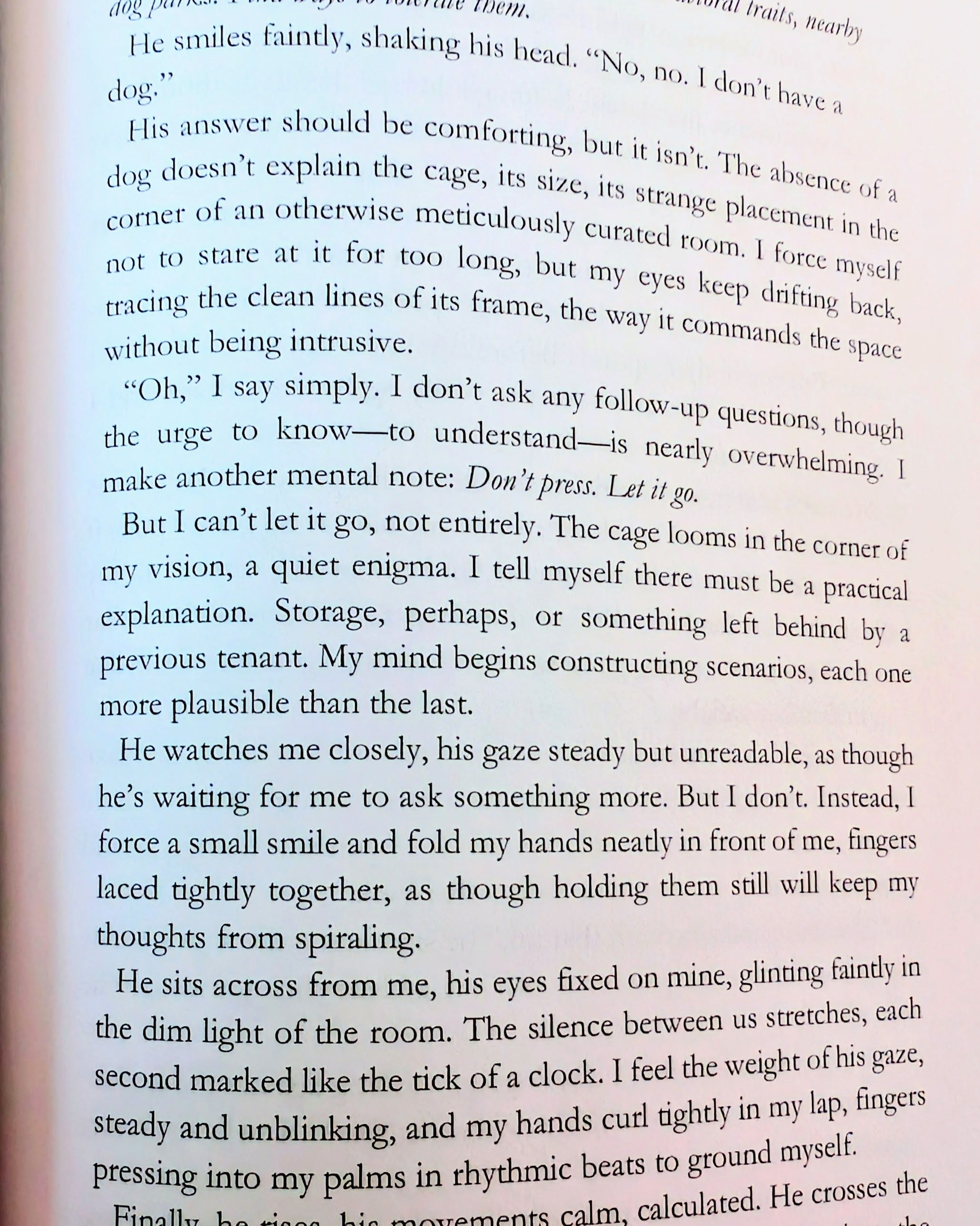
Nothing new gets introduced. The words are just there to put space on the page between the question and the answer.
So, now the million dollar question… do I think this book was AI assisted? And if so, how?
The super short version of this, entirely in my opinion, is yes. I think the LLM wrote most of the prose, while Mia Ballard probably came up with the plot (thumbs mostly up) and characters (thumbs mostly down).
But why do I think this? I certainly don’t have proof, and I’m not sure what could even constitute proof – I’m not going to go down the rabbit hole on the reliability of AI detection software here, but reportedly Pangram ran their test on a pirated copy of Shy Girl, which adds yet another wrinkle. And unlike Frankie’s Shelf, I have not catalogued linguistic patterns, nor did I much notice them as I read. I was actually excited to experience what Frankie describes as “a feeling” – uncanny and, in this case of undisclosed AI use, clearly unintentional – of inhuman prose.1 This didn’t strike me as uncanny, possibly because I’m reading more AI prose all the time than I’m consciously aware of.
Reading Shy Girl through the lens of LLM, though, the tell might be the prose’s compressibility. Each chunk of prose orbits around an event, but not tightly. I would expect characterization to take up more of that space, but the dialogue is on the nose and not much emerges organically from the characters’ body language or physicality, even when they’re perpetrating acts of intimate domestic or sexual violence. Only Turtle pops off the page, in a way that suggests (if I am correct) he was grown from a handful of lovingly concrete details not supplied to the others, and subject to several extra, eroticizing bouts of “computer, enhance.”
Would I have concluded that these elements (prose vs. plot) had been generated by separate entities if it weren’t for the existing discourse around this book and the expectations with which I approached it? Maybe, but certainly not with confidence. I’m not doing it with confidence now!
And what if both the prose and the plot were AI generated? Novelist Naomi Alderman, who has experimented with AI for fiction and video game plotting, observed in a recent Substack note that although those experiments lead her to conclude LLMs aren’t good at creating story outlines from scratch, “an objection has occurred to me about my analysis of AI outlining here. It is that I tend to mostly write novels which are ‘no one has ever really written a novel like this before.’ There is no prior art to rely on, and the AI definitely cannot outline them for me. perhaps if you write eg more formulaic thrillers then it can plot them?” This is a reasonable question, and worth testing out (my own efforts to use LLMs for fiction have also directed this tool toward atypical ends — another subject for another post).
However, in the case of Shy Girl, I don’t think it applies, because of the “what the fuck” factors listed above. Especially the human-to-dog transformation Gia experiences doesn’t have a clear causal relationship to the rest of the action, and the choice to have this take place over years rather than days or even months runs against at least some conventional thriller/horror wisdom about confining the action to a short span of time to up the intensity. (This is even true in more literary treatments of this type of material: Emma Donoghue’s Room also focuses on a mother and son who are imprisoned and abused for years, and yet Donoghue chooses to start the clock ticking on the present action shortly before the high stakes escape.)
All that said, it’s possible that Ballard didn’t use AI at all, used AI for everything, or used AI in a way that no one has yet correctly diagnosed. It is doubtless unfair to make a literal example of this book when there is no way to know, reliably, what it’s an example of. So should we just believe whatever its author says? Also no, at least not if we’re trying to do her any favors. Mia Ballard’s claim, so far, has been that a freelance editor may have inserted LLM language into the text, i.e. the weakest defense imaginable: Ballard is neither standing behind the authenticity of her work nor disclosing AI as a valued tool.
The dog who belongs on the cover of the book about this book is that one from the meme, wearing a tie, who has no idea what he’s doing. Not just because that’s the role Mia Ballard has played in this drama, but because that’s where we’re all at here. I see myself in him too.
*
The day I started writing this essay, Joshua Rothman published a New Yorker piece called “Is It Wrong to Write a Book With AI?” and although I wryly reference his drum machine metaphor in my list of obfuscating deflections above, I much prefer the question he raised later in his argument, when he writes, “If the creation of fiction is a layered endeavor—if premise, plot, style, and so on are to some extent separable—then must all the layers be made by the same individual?”
The metaphors that then follow feel less like brainteaser thought experiments than org chart templates: he discusses filmmaking and James Patterson’s novel factory, both narrative art forms that rely on hierarchical collaboration, an army of creatives in service of a higher plan. Rothman doesn’t keep it hypothetical, and neither will I. Why not an army of ghosts?
There are AI novel factories already, but I’ve been thinking about this question of ghostwriting for awhile now in relation to the current publishing turmoil over AI. It feels nostalgic, almost, since I used to think about ghostwriting all the time.
In the late 2000’s to early 2010’s, I was first a ghostwriter for Alloy Entertainment Group (I wrote two YA novels for them, and no, I will not say which ones), then I was an editorial assistant for a literary agent who took enthusiastic credit for discovering and popularizing James Patterson earlier in her career, when she had been his high-powered editor at Little, Brown… now part of Hachette, natch. In her subsequent role as an agent, she primarily worked with other “authors” – mostly figures in business, pop culture, or politics – most of whom, to an even greater degree than Patterson, did not write their own books.
It’s fair to say that leaving an MFA program in creative writing and entering a world where publishing is all ghostwriting, all the time, is a disillusioning experience. During this period, I remember reading David Foster Wallace’s “How Tracy Austin Broke My Heart,” his critique of a tennis star’s ghosted memoir, and reacting not-so-cleverly with an exclaimed “How DFW Broke My Brain!” How could this supposed intellectual giant not center his remarks on a simple fact he glosses over in the first sentence, the only fact that mattered, the fact that Tracy Austin did not write this book herself? How could he be surprised that “there’s not even a recognizable human being in here”? I was living in a sausage factory; I could affirm without cracking the pages that there would only be pink slime inside. DFW was impossibly naïve, and also upsettingly, freshly dead. He didn’t know, and now would never know, it was all pink slime, extruded from different nozzles: the YA nozzle, the thriller nozzle, the diet book nozzle, the airport business book nozzle, the celebrity tell-all nozzle. I was deep in the slime.
I did, eventually, have a nervous breakdown and seek psychotherapy, for this and numerous other reasons, and as I began putting my brain back together, three things happened. One of these was a particular writing workshop, which I’ll write about separately someday, maybe. But the other two are relevant: I got my first (what turned out to be mediocre and skippable, sorry) novel accepted for publication by (what turned out to be a hella shady, instant karma) small speculative fiction press, and in writing my second book, which became The Sky Is Yours, I decided to get serious about “doing genre” – intentionally employing established genre conventions without instantly subverting them, and sometimes without subverting them at all.
Workwise, I went part-time at a different agency that handled a lot more fiction, including mysteries, thrillers, and commercial women’s fiction, and I started to see that even genres I typically didn’t like could give me satisfying handholds, payoffs, bases for comparison. And connecting with Hella Shady: A Writer Beware Genre Press had one major upside: my association with them connected to the speculative fiction scene in NYC, where I have made some of my dearest friends. For awhile, I attended the Fantastic Fiction and NYRSF readings every month and Readercon annually.
And I started to think of the genre’s great strength – legibility – as a way out of the pink slime. When I had ghostwritten for Alloy, each book had begun with an in-office meeting, where the plot emerged over the course of an hour or so groupthink brainstorm, beat by cliched beat, in squeaky marker on a magical tech-enabled whiteboard that could capture and save these scrawlings as a digital file. It was a true case of story by committee, replete with the most corporate tools. In these meetings, the Alloy staffers were the first people I met who scooped out their bagels before consuming them, which struck me as metaphorically resonant; everything about this experience was a hollower version of something I loved. But, as Ottessa Moshfegh would later say about The 90-Day Novel by Alan Watt, it did one day occur to me: “if I were to do this, what would happen, would my head explode?”
By “this,” I meant employing the ghostwriter’s tools, or at least some of them. What if, instead of pandering to Earth’s shallowest fourteen-year-olds as imagined by a writers’ room of media-savvy cynics, I tried to pander… well, to myself? I used to have some vaguely defensible antipathy toward outlining my work – I wanted to “surprise myself,” I insufferably declared, though the big surprise was usually how little anyone cared. Clearly this was not the way. With what I was calling “the dragon book,” the real work became the outlines. Boredom was intolerable and to be avoided at all costs, I knew that from reading slush. And most causes of boredom, I had begun to realize, were structural. It was why my own previous novel had been so resistant to revision: because you can’t just shove a plot into a pile of writing, any more than you can shove bones into a protein smoothie and call it a skeletal system. I had been too precious about my prose to understand that I had made my own, perhaps even more unappetizing, DIY form of slime, and it hadn’t even held an intelligible shape.
I forced myself to think about what actually bored me, to divest myself of all pretensions but hedonism. It needed to be trash first, as close to trash as possible: schlocky, titillating, eventful. It needed to get a reaction if it was going to exist at all. “Go big or go home,” I told myself, like a mantra – followed by “I have no home,” as Bela Lugosi sez, in Ed Wood’s movie and the movie about Ed Wood. It was better to be Ed Wood than to be forgettable.
I realized that I liked escalations and payoffs and mysteries with at least partial solutions, direct conflict and violence and action sequences and sex scenes, enchantment and technology with consequences. I only rarely enjoyed a POV character lost in a reverie. This caused a shift in what I valued and took seriously in the work of other writers, too. Previously, sure, I’d registered annoyance when anyone on the literary side dismissed speculative imagery or concepts, because I had always used them, for all the reasons Jonathan Lethem so deftly summarizes in “What I Learned at the Science Fiction Convention”: before I was born, auteurs like Pynchon and Kubrick had proven beyond a shadow of a doubt that these elements could say Big Things, this was not ambiguous. In grad school, I’d had this argument over and over, sometimes in my head, as with the infuriating workshop instructor who told us that speculative concepts come and go but all great literature centers on relationships. Now, though, I was on the other side of the looking glass, regularly hanging out with people unironically active in various fandoms, some of whom regarded Lethem’s own midcareer forays toward realism with the skepticism folkies once reserved for Dylan going electric, and fuck. Maybe they had a point? Maybe a magic ring really should function as something more than a symbol in a story?
Pynchon and Kubrick (and Lethem, despite my razzing) were still my north stars, as were all the other virtuosic genre-benders, many of whom I encountered irl in these spec fic circles. But as I began to make a mental distinction between “speculative” (fantastical) and “genre” (hewing to established story conventions), I began to think I often had more to learn from a workmanlike urban fantasy than a literary work of sludgy interiority, even if both dabbled in the surreal. I tried reading The Stand and couldn’t handle how bad I thought the prose was, noping out at the passage below; it was downright painful to watch Stephen King try to evoke T.S. Eliot’s ambiance and wipe out so spectacularly.
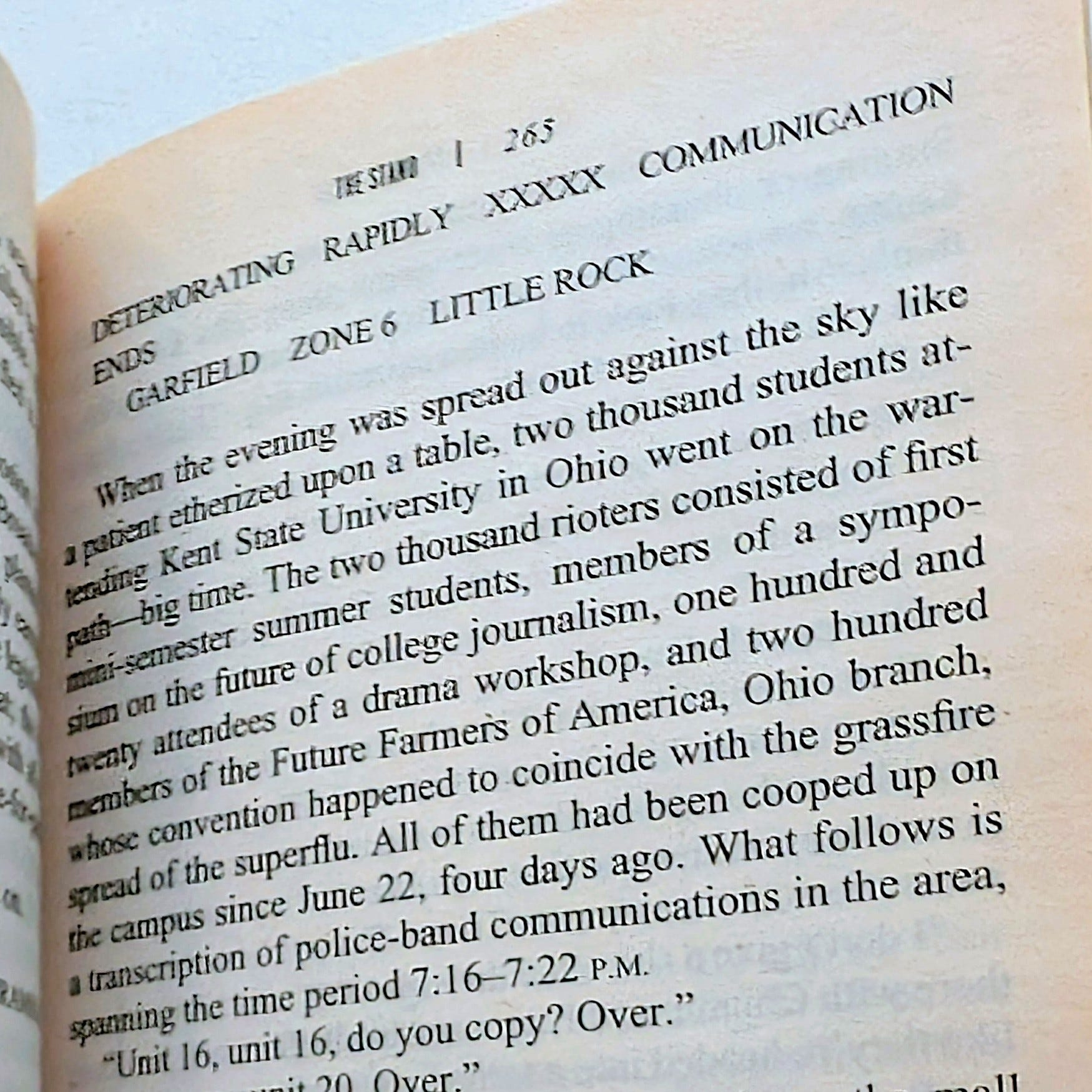
You may disagree with my assessment of King’s prose, but I didn’t disagree with myself. Yet this further proved my point too, in a way. I knew so many writers who I loved who were influenced by King, I had seen so many great adaptations of his books (and not just Kubrick’s unfaithful one). If I was noticing something real in King’s work, which I believed I was, it was obscuring a more important facet that others could see clearly. He was, and is, an undeniably great storyteller.
Storytelling is not a lesser skill than prose-craft. It is, however, a different one.
This is what makes the layers of the literary endeavor separable, as Rothman so wisely observes. This is an observable fact of literary art, because this is what makes ghostwriting possible, however one might feel about it, and if even I have been a ghostwriter, ghostwriting is all too possible. I would argue that one must understand an art form’s possibilities to understand its reality. But this is where things start to get weird.
To paint with an extremely broad brush, during this period (early to mid-2010’s), poptimism in the narrative arts was ascendant. That term can mean different things, but I’m talking about what started as a general “let people enjoy things” sentiment and escalated into “there is NO DIFFERENCE between any Marvel movie and Martin Scorsese’s best, in fact, more people like Marvel so it’s better!” Transposed over into fiction, this looked like a strange Ouroboros in which at least an adult reading YA was reading, and actually there was no difference between YA and adult fiction anyway, and in fact adult fiction should be more like YA, plus an audiobook2 was a novel, and a podcast was an audiobook, which was a novel, and a prestige TV show was also a novel, and who’s to say this other TV show isn’t prestige, and calling someone’s work formulaic is sexism, and there’s nothing wrong with using a formula. And these were the mainstream, bookish people, the people who, in my parents’ generation, would be reading Philip Roth and the book reviews they used to publish in the local paper.
But now I’m talkin’ about my generation, and I’m part of it too. For me, YA, audiobooks, podcasts, and TV shows all have value, overlap with adult novels in various ways and to various degrees, and are sometimes more worth their audience’s time. It’s annoying when people are dismissive of any particular mode of artistic expression, especially when that dismissal rests on a foundation of received ideas. But the conversation so often turned to dissolving distinctions that it’s worth asking why. And I have a theory… Dissolving distinctions disadvantages difficulty.
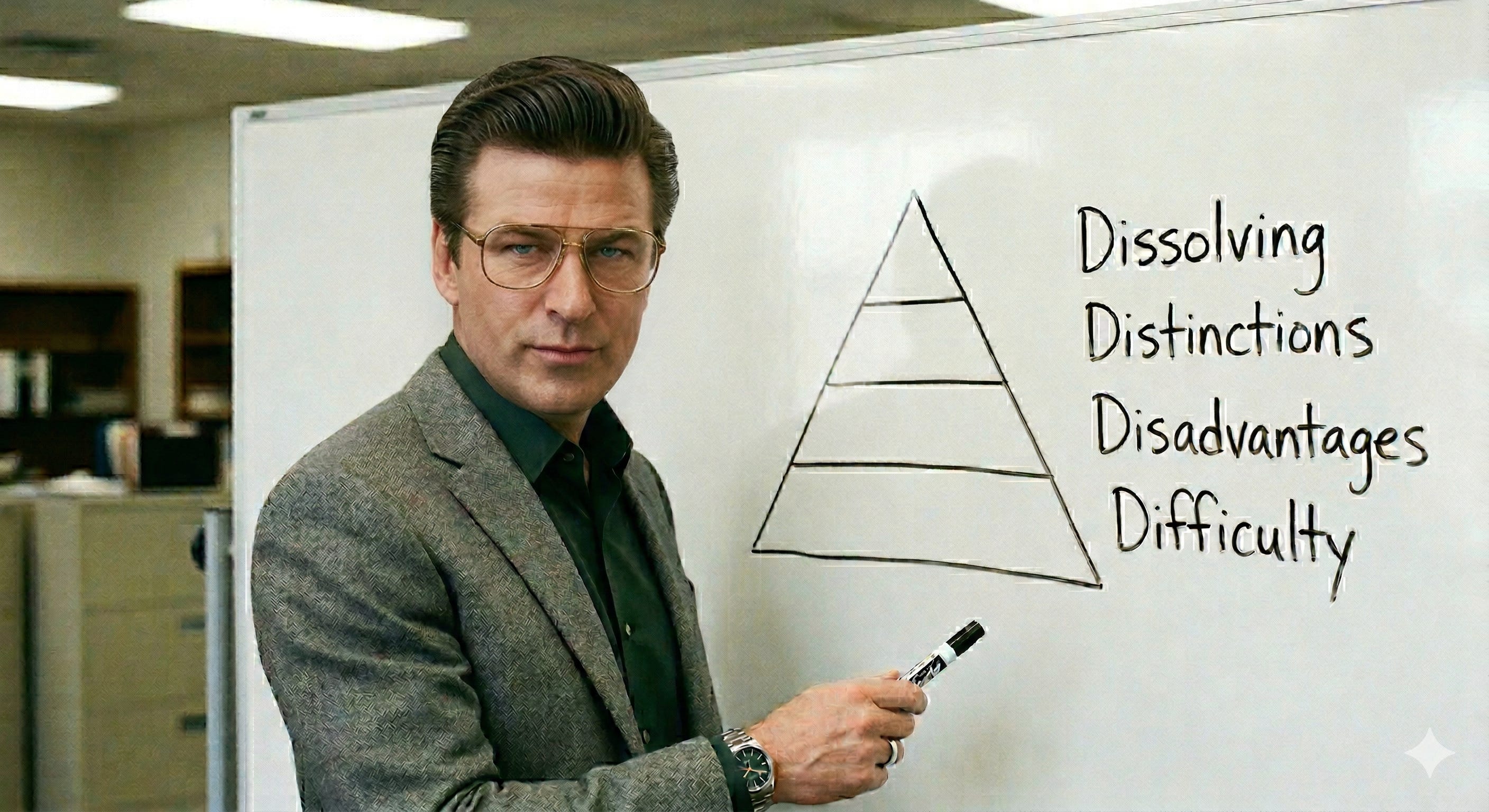
This is not a conspiracy; I do not think there was a plot to assassinate Big Difficulty (you only call Pynchon that if you know him really well). But I do think that poptimism’s rocket fuel, if you will, turned out to be that if one thing is difficult and another thing is easy, then saying there is no meaningful difference between these two will be a source of relief to many.
*
What is difficulty? Every person’s brain reacts differently to stimuli. Everyone has different intellectual strengths and weaknesses (and I’m not even getting into disability or neurodivergence). Sense of humor and taste and cultural knowledge and vocabulary all majorly inform what goes down easy for someone in terms of the written word. Difficulty isn’t a single quality; it’s a confluence of factors in the work, and an average of common reader reactions to that confluence. Difficulty fascinates me and I’m sure it will be a subject I return to again and again if I continue blogging.
However, I do think we can look to ghostwriting for an example of a process that is about producing non-difficult texts, where most difficulty is regarded as a mistake. Because, regardless of the reasons, difficult books take more time to consume. And ghostwriting is a volume business.
Which brings me back to my years in Genre World. I was drawn into Genre World, as I related above, because my ignorance of the tools of genre, the ghostwriter’s tools, had caused my fiction to suck. Notably, though, the fiction I wanted to write with knowledge of these tools was still difficult in major ways, and low volume since, at least for me as a writer, difficult fiction that does not suck takes a very long time to produce.
Another reason other smart people were attracted to Genre World was an attraction to a model that used the tools of genre, the ghostwriter’s tools, toward an operation that, in total, more closely resembled ghostwriting. Even though the author still did every piece of the project themselves, their end goal was a streamlined process, with an emphasis on outlining, meeting wordcounts, publishing regularly, and building an authorial brand heavily freighted with reliable associations. These folks also wanted to produce fiction that did not suck. But they were not aiming to be low-volume or difficult, and in fact actively avoided those outcomes.
In this case, we’re not even comparing different mediums or introducing a question about authorship: the difficult and the not-difficult writer as described here are both literally writing novels that are not works-for-hire; they are personally writing every word of these novels; these novels are equally likely to succeed on their own terms. Double-double D poptimism says, “What’s the difference? There is no difference,” and indeed, the difference is tricky to define without making the difficult work sound like a waste of time, especially to folks that already regard reading as effortful in comparison with more passive media consumption. Shorn of its prestige – which it still isn’t, completely, but semi-shorn, with the dearth of review coverage and the celebration of the non-difficult in much of what coverage remains – the difficult can seem almost indefensible. Reading a difficult book is isolating for most people, both when you’re doing it and if you want to share it with others, unless you’re in a book club or taking a class.
(To complicate matters still further, “difficult” vs. “not difficult” is not an on-off switch. I’m going to defend the thorny idea of “elevated [genre]” as at least a concept, because hybrids of these approaches exist. Of course we can argue about what goes in the “elevated” bucket, or quibble about the exact nature of the value judgment the “elevated” level smuggles in – that doesn’t make the bucket disappear. But I digress.)
The poptimism tsunami left writers in a very strange place for the dawn of these LLMs. I truly believe that there is space for difficult and non-difficult fiction, for works with all different degrees of AI assistance toward different ends, and for fiction written without any use of AI at all, as long as the literary community is able to talk openly and honestly about these distinctions. Choice is core to aesthetic discussion. When we read, we need to ask, what do these particular choices, in this particular case, center and value? What do they achieve successfully? And what do they shit the bed at doing? We should take these questions seriously, even though we will never arrive at consensus; intelligent people will inevitably disagree.
However, the idea now that we are instantly and unanimously supposed to celebrate books for being human-made – indeed, for being difficult to make – feels astonishingly mistimed.
Now let me circle back around, at long last, to Shy Girl.
*
I think Mia Ballard should have disclosed her use of AI when self-publishing and especially if she was contractually required to when she signed with Hachette. If she didn’t know what was in her own manuscript (*cough* bullshit *cough*), she should not have confidently made claims about its contents. I’m interested in AI-assisted fiction, but many other people aren’t, and they have the right to know what they’re consuming. Maybe this would have torpedoed her chances of building a readership and finding success, but if your success depends on misrepresenting the nature of your creative choices, it’s very precarious. I learned that from VH1.
Still, I have a hard time believing that the publisher didn’t know what risks they were taking here. This book was originally self-published with stolen cover art and sloppy formatting errors throughout. If AI was a concern on any level, this would be the type of book to suspect. Imo, they suspected it and they published it anyway.
So why didn’t they take the time to make Shy Girl… better?
I have yet to receive my UK-published edition of Shy Girl, and will update this when I do.3 Perhaps astonishing transformations happened on the page between these editions. Maybe an ambitious editor was trying to build the next James Patterson here. But I suspect not. Those poptimistic double-D’s come bouncing in once again, this time on the publishing side: why do the difficult work of coaching this author to improve their novel when it’s all the same, when there’s no obvious incentive, and the book is already making sales? The only bad thing that could happen, really, is what did happen, and Hachette can then dispose of Mia Ballard and pick up another similar author from the conveyor belt. It’s even possible that this was a test case to see if readers would notice or care, although that assumes a degree of forethought and calculation on Hachette’s part that I find unrealistic. It’s more likely to me that this is just one case among many of a publisher throwing literary spaghetti at the wall to see what sticks.
I certainly don’t think Hachette was naïve, or that they couldn’t figure out how to navigate the complexities of copyright law around this; Frankie’s Shelf nails this point too. Here on Substack, however, I recently got into a comments argument with a writer who appears to exclusively cover technology, especially AI. He claimed that Hachette was likely spooked by the Shy Girl LLM allegations since it’s “still unclear whether publishers can claim ownership over works generated in part by AI.” This seems credulous as fuck to me, since the US Copyright Office has already weighed in on this specifically, writing, “Copyright protects the original expression in a work created by a human author, even if the work also includes AI-generated material“ (emphasis mine). They continue, “Copyright does not extend to purely AI-generated material, or material where there is insufficient human control over the expressive elements. Whether human contributions to AI-generated outputs are sufficient to constitute authorship must be analyzed on a case-by-case basis.”
So this does not guarantee the copyrightability of every AI-generated artwork... but it does not disallow its copyrightability because of AI use. Work that includes AI generated material is held to the same standard of originality as work derived other ways. And there are already numerous, widely available examples of unambiguously AI-assisted creative and intellectual properties that meet this low bar of “sufficient human control.” For just one, in 2023, I Am Code: An Artificial Intelligence Speaks, a poetry collection which purportedly contains text entirely generated by AI, was copyrighted by its human “editors,” who arranged and curated its contents. The publisher? Hachette, natch.
Damn. So even Hachette forgot they published one of these already.
I plan to write future essays about other LLM fiction I’ve read, but this was the first I’ve encountered that was not marketed with or discussed in those terms from the beginning.
This point is too obvious to require a source, but reading about James Tate Hill’s passionate immersion in literature in his memoir Blind Man’s Bluff was tremendously moving and informative – a visually impaired person exclusively listening to audiobooks is of course in a different situation than a non-visually impaired person who’s free to make whatever decision they feel like about book format each time. My claim here is only that audiobooks are different than print books. In erasing that distinction, we erase that audiobook consumers are having a different experience, one that in the case of disability is part of a larger experience of difference that’s well worth exploring (ideally through excellent nonfiction like Hill’s).
I did receive the UK-published version and did a quick compare/contrast I describe at greater length in a note. Basically it appears to add some bonus features — a coda to the novel and a separate short story — without changing much if any of the original text. I did not go through every page, so it’s possible I missed something, but this is my impression.
Reading this has reminded me that I’m not used to reading long-form articles anymore. My brain has been turned into mush by the terse immediacy of social media. Still, I found this very interesting! (Especially as someone who has also done ghostwriting work!)
A super fascinating read! Especially loved the section where you talked about your own background in writing and publishing—your experiences were beautifully articulated and added a lot to your review of the (probably) AI book.